Free shipping over €49 ✨ | 3 interest-free installments from €50

WHITE, PINK, AND YELLOW CLAYS

KAOLIN / ILLITE / MONTMORILLONITE

It purifies, mattifies, detoxifies, exfoliates…clay does it all (or almost everything) for your skin! When you consider its many benefits, it’s easy to see why it’s used in so many natural cosmetics. Whether it’s white, green, yellow, or pink, it helps remove impurities, unclog pores, regulate sebum, and restore a fresh, radiant complexion. Listed in the ingredients as KAOLIN, ILLITE, or MONTMORILLONITE depending on its composition, clay is as gentle as it is powerful. We love it in masks, scrubs, or even in daily skincare routines… and here’s why!

Three piles of mineral powder in pink, green, and yellow clay on a white background

What Is Clay? — Definition

Clay is a natural mineral powder formed by the decomposition of rocks rich in aluminum silicates. Depending on its chemical composition, it may also contain iron, magnesium, zinc, or calcium. It is extracted from underground or open-pit quarries, then dried and finely ground. 

There are several types of clay used in cosmetics—the best known beinggreen clay (illite or montmorillonite),white clay (kaolin), andpink clay (a mixture of red and white clays), each with its own specific properties. 

Clays are 100% naturally derived ingredients that have not been chemically processed, making them ideal for clean, gentle yet effective formulas.

Liquid error (sections/block-content line 58): invalid URL input

Clay — How It Works

When applied to the skin as a paste (like a mask), clay acts like a mineral sponge. As it dries, it absorbs impurities, excess sebum, and pollution residues from the skin’s surface. This process, known as adsorption, helps unclog pores while deeply cleansing the skin without stripping it.

But that’s not all. Clay also has mild exfoliating properties. Its fine mineral particles help remove dead skin cells, resulting in a brighter, more even complexion. The skin’s texture is visibly smoothed, and the skin feels softer to the touch.

Certain types of clay, such as white or pink clay, also have soothing properties. They help calm redness and alleviate feelings of discomfort. This is one of the reasons they’re often used in skincare products for sensitive skin.

Finally, clay acts as a natural balancer. It helps regulate sebum production without drying out the skin.

Woman wearing a green face mask and a pink towel on her head

Benefits of Clay for the Skin

Clay is a multi-action ingredient with numerous benefits:

Purifying: It cleanses, purifies, and sanitizes the skin.

Absorbent: It removes excess sebum without irritating the skin.

Exfoliating: It helps unclog pores and remove dead skin cells.

Mattifying: It reduces shine, especially in the T-zone.

Detoxifying: It captures impurities and pollution residues.

Soothing: It calms redness and relieves discomfort.

Clarifying: It restores radiance to the complexion.

Smoothing: It refines skin texture and makes the skin softer.

Liquid error (sections/block-content line 58): invalid URL input

Are clays suitable for all skin types?

Yes, but not just any way. There are as many types of clay as there are skin types, and that’s exactly what makes this ingredient so interesting.

Those with oily or combination skin will love green clays or montmorillonite clays, which are highly absorbent and ideal for regulating sebum and purifying the skin.

Those with sensitive, dry, or mature skin will prefer gentler clays like kaolin (white clay) orpink clay, which cleanse without causing irritation.

Another plus: clay is suitable for all skin tones, from the lightest to the darkest, without any risk of depigmentation or specific irritation. It’s also suitable for all age groups, whether for young skin seeking purity or mature skin looking to regain radiance and softness.

Liquid error (sections/block-content line 58): invalid URL input

Clay in Cosmetics

Clay is found in a wide variety of cosmetic products: purifying masks, exfoliating treatments, facial cleansers, mattifying patches, and even bar soaps. It’s particularly useful in skin detox routines or for a quick treatment before an important event to instantly restore a fresh complexion.

Contraindications and side effects: If used too frequently or not rinsed off properly, clay can dry out certain skin types or cause minor redness. It should be avoided on broken or severely irritated skin. Highly absorbent clays (such as green clay) should be used sparingly on dry or sensitive skin.

Usage and Application Tips: Use it as a mask 1 to 2 times a week on clean skin. Avoid letting it dry completely to prevent drying out the skin: spray a little thermal water or use a mask enriched with moisturizing active ingredients. Rinse with lukewarm water, then apply a suitable moisturizer.

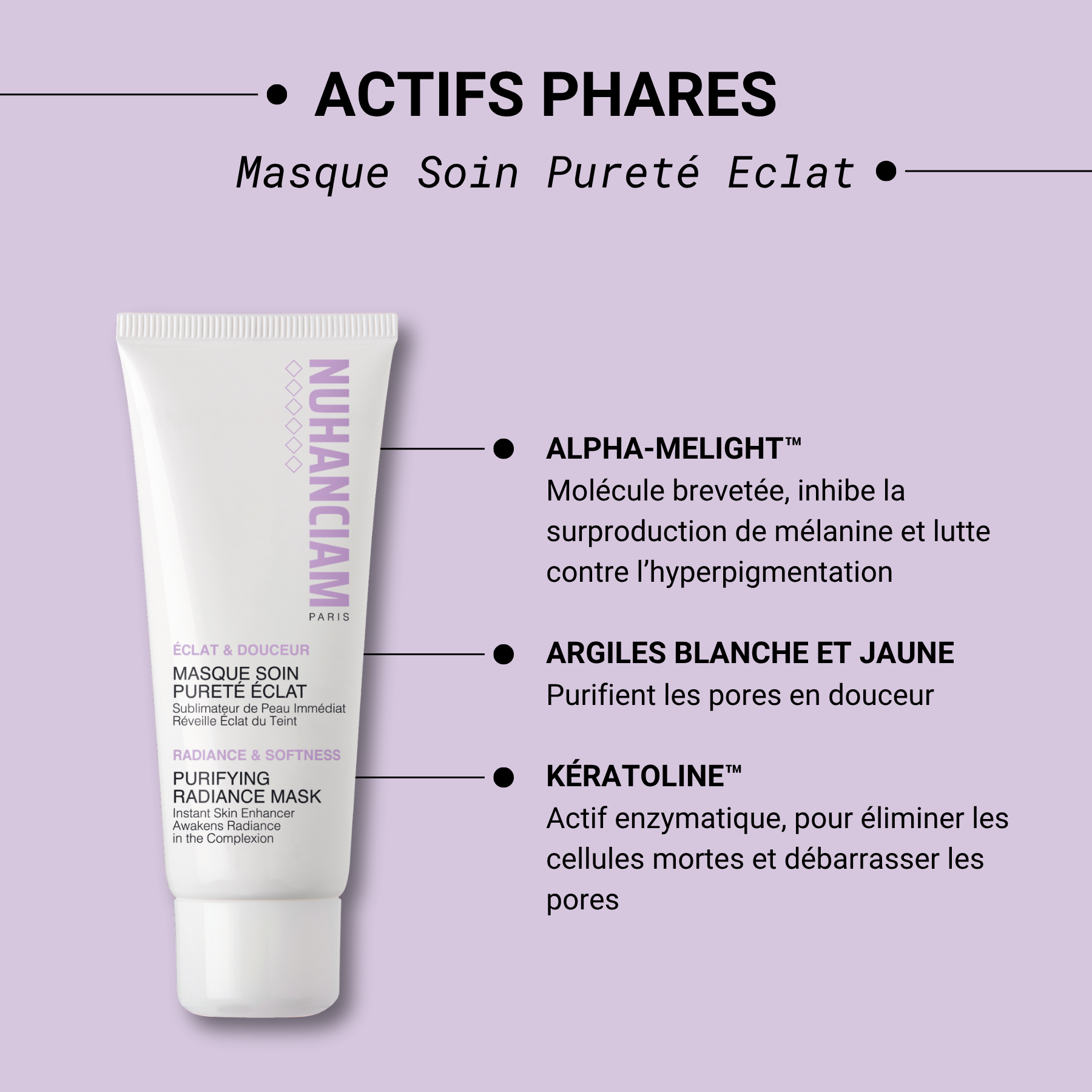
At NUHANCIAM, we incorporate clay into our formulas for its ability to gently purify without irritating the skin. It is a naturally derived ingredient whose targeted efficacy and extreme versatility make it an essential active ingredient in our approach to skincare that respects every skin tone.

Purifying Radiance Mask by Purifying Radiance Mask , 75ml, in a purple box